
留言
如果您对我们的产品感兴趣并想了解更多详细信息,请在此处留言,我们会尽快回复您。

In modern industrial formulations, maintaining phase stability under extreme stress—such as shear forces, varying temperatures, and hard water exposure—presents a constant challenge. Synthetic fluid developers, chemical blend engineers, and plant managers rely on advanced amino alcohols to maintain chemical equilibrium and maximize product life. Monoisopropanolamine MIPA has emerged as a preferred neutralizing agent and building block across metalworking, agricultural emulsification, and specialty chemical synthesis.
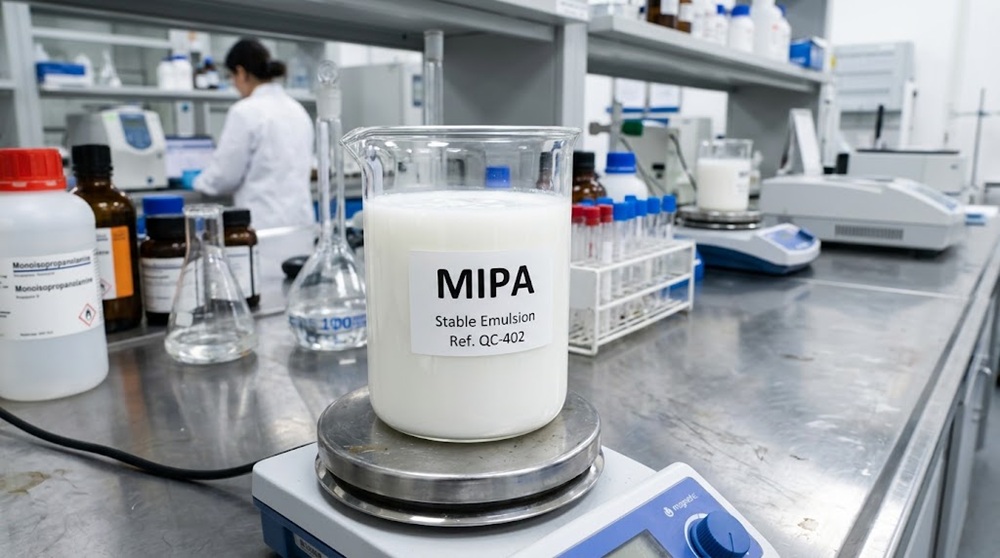
Achieving long-term emulsion stability requires precise surface tension reduction and robust electrical double-layer defense at the oil-water interface. Traditional neutralizing bases, such as sodium hydroxide or triethanolamine (TEA), often struggle with excessive water absorption, volatile odors, or rapid degradation under mechanical stress.
Monoisopropanolamine MIPA addresses these core physical limits:
Steric Hindrance: The branched molecular structure of MIPA provides steric shielding around the polar group, reducing hydrolytic degradation and preventing phase separation.
Balanced Alkalinity & pH Buffer: MIPA acts as a highly efficient buffering base, stabilizing formulation pH without creating high-salinity micro-environments that weaken surfactant structures.
Improved Salt Compatibility: In hard water applications, MIPA resists forming insoluble calcium and magnesium precipitates, ensuring low turbidity and steady performance.
The metalworking industry requires chemical fluids to perform dual roles: high-lubricity heat transfer and robust corrosion prevention. Formulation chemistry relies heavily on alkanolamines to neutralize fatty acids, forming soluble soaps that serve as primary emulsifiers.
In metalworking chemicals, MIPA reacts with fatty acids (such as oleic or tall oil fatty acids) to generate high-solubility alkanolamine soaps. These soaps exhibit low foaming tendencies and superior reserve alkalinity compared to traditional triethanolamine salts.
For soluble oils additives, MIPA enhances the dispersion of mineral oils, synthetic esters, and bio-based basestocks in water. By forming tight, nano-scale micellar dispersions, it prevents oil droplet coalescence, eliminates scum formation, and extends the bath life of metal-cutting fluids. Furthermore, its gentle nature minimizes skin irritation while preventing staining on non-ferrous metals such as aluminum and yellow copper alloys.
The effectiveness of monoisopropanolamine MIPA extends beyond basic neutralization. Within broader surfactant chemistry, MIPA serves as an intermediate for non-ionic and anionic surfactant manufacturing, including isopropanolamides and sulfosuccinates. These derivatives exhibit higher solubility in organic solvents and faster dynamic surface tension reduction than their ethanolamine counterparts.
Combining MIPA-neutralized fatty soaps with ethoxylated fatty alcohols yields microemulsions that remain clear and stable across wide temperature variations.
Formulating high-performance emulsions requires raw materials with consistent purity, low moisture content, and precise amine value specifications.
Bewellchem products include high-grade monoisopropanolamine MIPA tailored for industrial synthesis, metalworking fluid concentrates, and specialty emulsifier blends. Through strict quality control and global logistics networks, Bewellchem provides reliable chemical solutions designed to overcome complex emulsification challenges. Contact our technical team today to optimize your formulations.


留言
扫描关注微信 :

扫描至 WhatsApp :


 支持 IPv6 网络